Monday, May 22, 2024

Luggage durability tests that actually predict breakage
For quality control and safety managers, luggage durability is not proven by dramatic one-off lab stunts. It is proven when a test result matches real breakage in transit, storage, and repeated travel cycles.
The most useful luggage durability program predicts cracked shells, loose wheel housings, bent handles, burst seams, and failed zippers before claims appear. That requires scenario-based testing, not isolated spectacle tests.
This article explains which luggage durability methods actually forecast field failure, where common protocols miss risk, and how to build a more predictive evaluation system.
Why luggage durability must be judged by travel scenarios, not lab theater
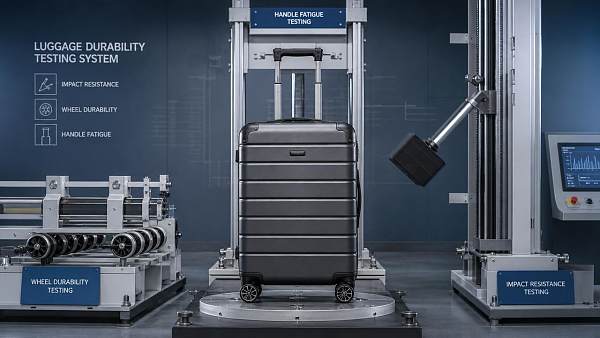
A suitcase rarely fails from one extreme event alone. Real damage usually comes from cumulative abuse across check-in belts, curb drops, vehicle vibration, overpacking, and rough pulling over uneven ground.
That is why luggage durability should be tied to failure pathways. Shell materials crack after repeated impact plus cold exposure. Wheels fail after side loading, contamination, and rolling fatigue. Handles weaken through cyclic extension under misaligned loads.
A test can look severe and still be poor at prediction. If the load path, frequency, restraint condition, or temperature does not reflect use, the data may impress but mislead.
Scenario 1: Airport transfer abuse is the best predictor of shell and corner breakage
For hardside products, the strongest luggage durability predictor is repeated impact testing with realistic mass, corner orientation, and temperature conditioning. Single dramatic drops are less useful than controlled, repeated impacts.
Corner and edge zones deserve special attention. Most cracks start near stress concentrators, wheel mounts, zipper tracks, and molded transitions. Flat-panel impact alone often underestimates breakage risk.
What to test in this scenario
- Repeated drop tests at packed weight, not empty case weight.
- Corner, edge, and wheel-side impacts in rotating orientations.
- Conditioning at low and room temperatures before impact.
- Post-impact checks for hidden cracking, latch shift, and wheel alignment.
Low-temperature impact matters because polymers can shift from tough to brittle behavior. A shell that survives warm-room testing may crack badly after cargo hold exposure or winter ground handling.
For luggage durability, the key metric is not only visible fracture. Permanent deformation, zipper distortion, and wheel housing movement often forecast future failure after a few more trips.
Scenario 2: Long terminal walks reveal the wheel tests that truly predict failure
Wheel failure is one of the most common luggage durability complaints. Yet many wheel tests only measure straight rolling on smooth surfaces. Real travel loads are rarely that simple.
Predictive wheel testing must combine rolling distance, obstacle strikes, side pull, and contamination. Casters usually fail from bracket looseness, axle wear, tread chunking, or housing cracks under turning stress.
More predictive wheel methods
- Rolling fatigue on mixed surfaces, including joints and textured flooring.
- Obstacle crossing with realistic speed and loaded mass.
- Side-drag cycles to simulate misaligned pulling and sharp turns.
- Debris exposure to assess hair, dust, and grit intrusion.
The most useful luggage durability insight here is retention of function. A wheel that still rotates but wobbles, binds, or tilts should be considered at risk, even before complete collapse.
Scenario 3: Repeated packing and lifting expose handle fatigue better than static loads
Handles rarely fail because someone exceeded one static load for one second. They fail after thousands of extension, retraction, lifting, and twisting events with partial shock loading.
Static pull tests have value, but cyclic fatigue testing predicts luggage durability far better. Telescopic handles especially suffer from play growth, button wear, tube bending, and lock disengagement.
Key handle evaluation points
- Extension and retraction cycle counts under load.
- Lift-and-drop micro-shock cycles during curb handling.
- Torsion checks when pulling at off-axis angles.
- Lock reliability after wear and contamination.
Softside carry handles and top grips should also be tested for stitch creep and local material cutting. Webbing strength alone does not guarantee luggage durability at sewn attachment points.
Scenario 4: Overpacking pressure shows whether zippers and seams will survive real use
Many returns blamed on shell quality actually start at closure systems. Zippers, expansion gussets, and seam lines experience complex pressure during overpacking and sitting compression.
For luggage durability, seam burst and zipper burst tests become more predictive when the case is packed with uneven contents. Uniform fillers can hide localized stress peaks.
What makes closure testing realistic
- Uneven packing profiles with hard and soft contents.
- Repeated opening and closing after compression.
- Slider retention checks after corner impacts.
- Seam inspection for stitch slippage, not only rupture.
A zipper that survives tensile force but derails after torsion is a weak link. Predictive luggage durability testing must capture alignment stability as well as simple strength.
How luggage durability needs differ by use case
How to build a more predictive luggage durability protocol
The best luggage durability program combines tests into a sequence that mirrors travel life. One test should precondition the next, because many failures emerge only after earlier damage has weakened the structure.
Recommended sequence
- Condition samples by temperature and humidity.
- Pack to realistic mass with uneven internal loading.
- Run impact and drop cycles first.
- Then perform wheel rolling and obstacle tests.
- Follow with handle fatigue and closure cycling.
- End with functional and cosmetic inspection.
This sequence improves luggage durability prediction because hidden crack growth, mount shift, and part looseness affect later performance. Separate fresh-sample tests can miss these interactions.
Common mistakes that make luggage durability data unreliable
One mistake is relying on empty-sample testing. Light loads reduce stress at wheels, shell corners, and telescopic assemblies, producing false confidence.
Another mistake is recording only pass or fail. Trend data matters more. Wheel wobble angle, handle play, crack length, and zipper force change can predict future claims earlier.
A third mistake is using unrealistic fillers. Foam blocks do not behave like shoes, books, chargers, and packed clothing. Internal load shape strongly affects luggage durability outcomes.
Finally, test teams often ignore post-test teardown. Fastener pullout, hidden rib whitening, and axle wear patterns provide the root-cause evidence needed for better design decisions.
Practical next steps for improving luggage durability decisions
Start by mapping the top three field failures to the exact use scenarios behind them. Then match each failure mode with a test that reproduces the same stress path.
Next, replace isolated headline tests with linked sequences. Use loaded samples, temperature conditioning, and mixed-surface motion to make luggage durability results more meaningful.
Document not only breakage, but also degradation. Early looseness and distortion often matter more than catastrophic failure when evaluating luggage durability for long service life.
A stronger protocol does not need more spectacle. It needs better correlation. When tests mirror real handling, luggage durability data becomes a reliable guide for design refinement, claim reduction, and safer product release.

The Archive Newsletter
Critical industrial intelligence delivered every Tuesday. Peer-reviewed summaries of the week's most impactful logistics and market shifts.