Monday, May 22, 2024

How biomechanics explains power, balance, and fatigue
Biomechanics reveals why power output rises or breaks down, how balance is maintained under dynamic load, and what truly drives fatigue across movement systems.
For technical evaluation across recreation, fitness, educational, and performance products, biomechanics turns claims into measurable variables.
It connects force production, joint alignment, energy transfer, and user safety.
That makes biomechanics essential when judging treadmills, training tools, balance toys, musical interfaces, and travel gear used under repeated load.
Why biomechanics matters in real evaluation scenarios
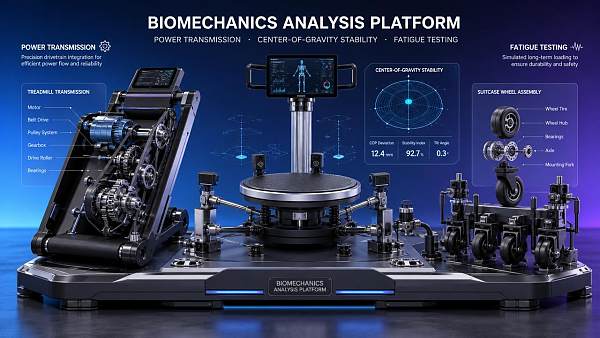
In practical settings, biomechanics is not an abstract science.
It is the framework used to explain whether motion is efficient, stable, repeatable, and safe.
A child using a coding robot, a runner on a commercial treadmill, and a musician sustaining posture all face different movement demands.
Yet the same biomechanics questions apply.
- Where does force start, and where is it lost?
- How is balance preserved when the body or tool moves?
- Which tissues or structures fatigue first?
- Does the design support natural mechanics or fight them?
For RLES-linked product intelligence, biomechanics helps compare function beyond marketing language.
It supports more accurate judgments on usability, durability, comfort, and injury risk.
Scenario one: assessing power output in fitness and sports equipment
Power in biomechanics is the rate of doing work.
In equipment testing, that means asking how quickly force becomes movement without harmful waste.
A treadmill, rower, bike, or resistance station can increase power expression or suppress it.
The key is how the machine interacts with stride, timing, impact, and return energy.
Core judgment points for power
Biomechanics shows that strong output depends on alignment and sequencing.
If the ankle, knee, hip, trunk, and upper limbs coordinate well, force travels efficiently.
If one segment collapses, energy leaks.
- Deck cushioning that reduces shock without over-softening push-off
- Motor response that matches acceleration demands
- Handle placement that avoids trunk compensation
- Surface grip that preserves foot stability during force transfer
When biomechanics is ignored, equipment may feel impressive but reduce actual power economy.
That often appears as noisy impact, unstable cadence, or early lower-limb fatigue.
Scenario two: understanding balance under dynamic load
Balance is not simply standing still.
In biomechanics, balance is the continuous control of the center of mass over a changing base of support.
This matters in agility tools, children’s activity products, rehabilitation devices, and even wheeled luggage.
Any product that shifts load or changes direction affects balance behavior.
Where balance succeeds or fails
Biomechanics explains balance through sensory input, muscular response, and mechanical design.
A stable system lets users make quick corrections with minimal wasted motion.
An unstable design forces exaggerated compensation.
In travel products, poor handle geometry can rotate the trunk and overload one side.
In educational play systems, an awkward center of mass can reduce motor confidence.
In sports platforms, delayed surface feedback can disrupt landing control.
Scenario three: identifying what really drives fatigue
Fatigue is often described too loosely.
Biomechanics separates fatigue into mechanical inefficiency, muscular overload, repetitive impact, and posture-related strain.
That distinction matters when evaluating long-duration use.
A product may not fail structurally, yet still produce rapid user fatigue.
Typical fatigue triggers across sectors
- Excessive vibration reaching joints or soft tissue
- Poor grip diameter increasing forearm demand
- Repeated asymmetry in pulling, carrying, or pressing
- Postures requiring constant low-level stabilization
- Energy return systems that are mistimed or inconsistent
Biomechanics is especially useful here because fatigue usually begins before visible form breakdown.
Measuring contact patterns, joint angles, and movement variability reveals problems earlier.
How scenario demands differ across recreation and performance products
Different applications require different biomechanics priorities.
The table below highlights how judgment criteria shift by scenario.
Practical biomechanics adaptation suggestions
Better decisions come from matching biomechanics criteria to actual use conditions.
The following actions improve scenario fit.
- Test under repeated cycles, not single demonstrations.
- Compare novice and skilled movement responses.
- Track where compensation appears first.
- Evaluate left-right symmetry during use.
- Check whether adjustability preserves alignment.
- Review vibration, rebound, and contact surface behavior together.
In biomechanics, isolated numbers rarely tell the full story.
A high power reading, for example, may hide poor balance control or rising fatigue cost.
Common misjudgments when biomechanics is overlooked
One frequent mistake is assuming softer always means safer.
Biomechanics shows that too much compliance can destabilize force transfer and increase muscular demand.
Another error is focusing only on peak output.
Sustainable movement quality matters more than a short burst of performance.
A third issue is ignoring user variability.
Different heights, limb lengths, skill levels, and fatigue thresholds change biomechanics outcomes significantly.
- Do not separate comfort from biomechanics.
- Do not judge balance from static posture alone.
- Do not treat fatigue as only a conditioning problem.
A smarter next step for biomechanics-based evaluation
Biomechanics explains power, balance, and fatigue by making movement measurable.
That is valuable across the RLES landscape, from commercial fitness systems to educational play, musical interaction, and mobile gear.
The most useful approach is scenario-first evaluation.
Define the movement demand, identify the likely failure point, then test how the design supports efficient mechanics.
When biomechanics guides assessment, product decisions become clearer, safety analysis becomes sharper, and performance claims become easier to verify.
Use biomechanics not as a buzzword, but as a practical filter for better engineering, better product intelligence, and better human experience.

The Archive Newsletter
Critical industrial intelligence delivered every Tuesday. Peer-reviewed summaries of the week's most impactful logistics and market shifts.