Monday, May 22, 2024

Which Luggage Tests Best Predict Wheel and Handle Durability?
The tests that best predict luggage wheel and handle durability are the ones that reproduce the combined forces of real travel: repeated rolling under load, sharp impacts at obstacles, twisting during turns, off-axis pulling, and thousands of extension-and-retraction movements. A basic drop test remains useful for judging shell and corner resistance, but it rarely exposes the fatigue failures that cause a wheel to wobble, a housing to crack, or a telescopic handle to jam after repeated use.
A credible durability assessment treats the wheel, wheel housing, axle, handle tubes, locking mechanism, and their mounting points as one load path. A suitcase may have smooth-rolling wheels and a sturdy-looking handle when new, yet fail when the wheel housing flexes under load and transfers stress into the lower shell. The most revealing test program therefore combines motion, impact, load, and post-test functional inspection.
Rolling-distance testing reveals fatigue that static tests miss
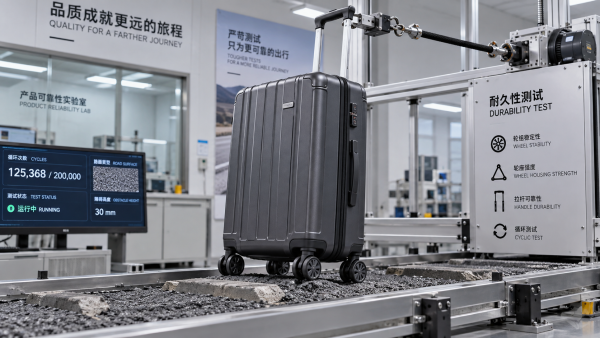
Rolling-distance simulation is one of the strongest predictors of wheel durability because travel cases spend much of their service life moving rather than falling. The case is loaded to a defined mass, pulled or pushed through repeated travel cycles, and evaluated for wheel rotation, tracking, noise, looseness, and bearing condition.
The test surface matters as much as the distance. A smooth belt or polished floor can demonstrate basic rolling efficiency, but it puts little stress on the wheel tread, axle retention, fork, or housing. More representative setups include textured panels, joints between panels, shallow ridges, coarse pavement-like surfaces, and mixed transitions. These introduce cyclic shock into the assembly and reveal whether the axle bores enlarge, fasteners back out, or the wheel begins to develop side play.
Wheel diameter changes the meaning of the result. Small wheels strike surface irregularities more frequently and at steeper approach angles. Larger wheels may roll more easily over gaps, but their longer lever arm can increase force on the housing during side impacts. A rolling test should therefore be compared only among cases with similar wheel geometry, load class, and travel orientation. A long test performed with an unusually light load is less informative than a shorter, correctly loaded test on a demanding surface.
After the run, inspection should go beyond asking whether the wheels still turn. Useful observations include uneven tread wear, flat spots, reduced free rotation, changes in pull force, axial movement, cracking around screw bosses, deformation of wheel forks, and contact between the wheel and its housing. A wheel that remains intact but becomes noisy or resistant is already showing a likely field-return issue.
Obstacle-impact testing exposes weak housings and axle retention
Obstacle-impact testing is especially valuable because curbs, door thresholds, elevator gaps, uneven tiles, and baggage-transfer edges create short, high-force events. During travel, these impacts are often applied while the case is loaded and moving, which produces a very different stress pattern from a stationary drop.
A useful obstacle test repeatedly drives the loaded case into a fixed step, bar, or edge at controlled speed. The wheel should approach from the direction it would experience during pulling, but reverse-direction impacts also deserve attention. Spinner luggage can be pushed sideways, turned abruptly, or dragged with only part of the wheel set in contact with the ground. Those conditions place bending stress on the fork and torsion stress on the wheel mounting plate.
Impact height should be selected in relation to wheel size and intended use rather than treated as a universal value. An obstacle that is minor for a large outdoor-oriented wheel can be severe for a compact cabin case. The point is not merely to create dramatic damage; it is to determine whether repeated shocks cause progressive loosening before visible breakage occurs.
Watch for differences between immediate failure and cumulative failure. An immediate fracture often points to brittle housing material, thin wall sections, poor rib placement, or a sharp internal corner near a fastener. Progressive wobble more often indicates wear at the axle interface, fastener relaxation, creep around an insert, or repeated flexing of the shell panel behind the housing. These problems require different corrective actions, so they should not be recorded under a single result such as “wheel passed.”
Handle cycle testing must include load and misalignment
Telescopic handles are commonly tested by extending and retracting them repeatedly. This identifies wear in the release button, lock pin, guide channel, tube interface, and internal linkage. A meaningful cycle test measures more than whether the handle still locks at the end of the sequence. It should also record changes in extension force, release force, locking clarity, rattle, uneven tube travel, and incomplete retraction.
Unloaded cycling is useful for checking mechanism life, but it is not enough to predict travel use. Pulling a loaded suitcase puts bending force into the tubes and concentrated stress into the handle seat. The most revealing version adds a representative load and applies it at the grip while the handle is extended. Small off-axis forces are particularly important because cases are rarely pulled perfectly straight. A handle may feel firm under a centered vertical load yet bind when the left and right tubes see unequal resistance.
Side-load and torsion evaluation separates robust handle systems from designs that only perform in a straight-line laboratory motion. The grip can be pulled slightly left or right, or the case can be rolled through turns while the handle is extended. The aim is to see whether the tubes remain parallel, whether one lock disengages before the other, and whether the guide tracks deform. A system that develops a small amount of play can still be serviceable; a growing mismatch between the two tubes is more concerning because it often leads to jamming.
Tube material alone does not determine the outcome. Aluminum tubes can resist corrosion and offer low weight, while steel may provide higher stiffness in certain dimensions. Yet wall thickness, tube profile, rail clearance, locking-pin geometry, surface finish, and the stiffness of the surrounding shell structure often determine handle life more directly. Excess clearance can create rattle and accelerated wear. Too little clearance can cause binding after minor shell distortion or temperature-related dimensional change.
Loaded pull tests connect wheel and handle performance
A loaded pull test is one of the most practical ways to assess the complete running system. The case is packed or ballasted, its handle is fully extended, and it is moved through straight paths, turns, surface transitions, and controlled obstacles. Pull force, directional stability, handle deflection, and wheel behavior should be observed together.
This test catches failures that isolated component tests can hide. If the wheel set has high rolling resistance, users tend to pull harder. That extra force bends the telescopic handle and increases stress at the handle seat. If the handle flexes excessively, the pulling angle changes and can place abnormal side load on the wheels. A durable product needs compatible behavior across the full assembly, not merely high scores from separately tested parts.
Drop testing still matters, but the drop orientation changes its value
Drop tests are most useful when their orientation targets the assemblies under review. A flat drop mainly evaluates the shell’s broad-area impact response. Corner drops put more localized stress into shell edges, zipper tracks, frame joints, and wheel housings. A drop onto the wheel side can reveal whether the wheel module protects itself through controlled deformation or transmits force directly into a thin shell section.
Test mass deserves careful control. An empty suitcase can survive a drop that would crack at the wheel mounting zone when loaded. Conversely, an unrealistically rigid ballast may concentrate force in ways that ordinary packed contents would not. The internal load should be stable enough to prevent uncontrolled shifting while still representing the way packed items distribute mass through the case.
Inspect alignment after each impact rather than waiting until the final drop. A telescopic handle that still extends may have shifted slightly at its lower mounts. That shift can later produce rubbing, uneven tube engagement, or lock failure during cycling. Wheel modules should be checked for changes in wheel clearance, mounting gaps, and rotation under load.
Environmental exposure is useful when linked to a physical test
Temperature and moisture exposure do not replace mechanical testing, but they can reveal whether materials and clearances remain stable before a rolling or handle test begins. Cold conditions can reduce impact toughness in some polymers. Heat can increase creep around wheel-housing fasteners or alter the fit of telescopic-handle guides. Moisture and salt-like contamination may affect bearings, springs, fasteners, and coatings where protection is incomplete.
The most meaningful sequence is environmental conditioning followed by a relevant mechanical action: rolling after cold exposure, obstacle impact after heat exposure, or handle cycling after humidity exposure. Testing only the appearance of a component after conditioning provides limited evidence. Functional changes such as increased handle force, delayed lock engagement, wheel noise, corrosion residue, or a sticky release button are more useful signals.
Reading results without overvaluing a pass
A passing result should include functional thresholds, not simply the absence of a broken part. Wheel rotation, lateral movement, tracking, pull effort, handle lock engagement, tube alignment, and shell integrity all matter. A case that completes the test but requires noticeably more force to pull has not delivered the same durability outcome as one that retains stable travel performance.
Comparisons are only reliable when wheel count, wheel diameter, wheel construction, case size, load, path geometry, obstacle profile, and test sequence are aligned. Four-wheel spinners and two-wheel pull cases load their hardware differently. Soft-sided luggage can flex around mounting points in a way that differs from hard-shell polycarbonate or ABS constructions. A reinforced wheel housing can still fail if the surrounding shell lacks support, while a strong shell cannot compensate for a poorly retained axle.
The best predictor is therefore a test matrix rather than a single headline test: loaded rolling over mixed surfaces, repeated obstacle strikes, handle cycling under load, side-force evaluation, and targeted drop testing of wheel and handle zones. When these methods are documented with before-and-after measurements and component-level observations, they reveal durability trends well before a visible break occurs.

The Archive Newsletter
Critical industrial intelligence delivered every Tuesday. Peer-reviewed summaries of the week's most impactful logistics and market shifts.