Monday, May 22, 2024

How Can Suppliers Verify Biomechanics in Fitness Equipment Design?
A fitness machine can look stable on a showroom floor and still guide a user into poor joint positions once resistance, speed, and fatigue are involved. A treadmill deck that feels harsh at heel strike, a chest press with handles that force the shoulders forward, or a leg extension with a poorly located pivot can all create complaints that are difficult to trace back to one visible defect. For suppliers, the practical question is not whether a machine “moves,” but whether it supports a safe, repeatable human movement across its intended user range.
How can a supplier verify biomechanics in fitness equipment design? The most reliable approach combines dimensional review, motion-path analysis, adjustable-fit testing, load and force assessment, prototype trials with representative users, and documented safety verification. Biomechanics should be checked before tooling is finalized, then rechecked on production samples because small changes in parts, padding, weldments, bearings, or resistance calibration can alter the user experience.
Start with the movement the equipment is supposed to support
Biomechanical verification begins with a clear definition of the intended exercise. A supplier should identify the primary joints involved, the expected movement plane, the intended range of motion, the user posture, and the direction of external resistance. Without this reference, a design review can become subjective: one reviewer may call a movement “comfortable” while another may focus only on frame strength.
For example, a seated rowing machine should permit coordinated shoulder extension, elbow flexion, and torso control without requiring the user to shrug excessively or round the spine to reach the handle. A leg press should allow knee and hip flexion within a usable range while avoiding a footplate relationship that drives the pelvis into excessive posterior tilt near the bottom position. A treadmill should support a predictable walking or running pattern without sudden changes in deck response, belt tracking, or incline behavior.
The design brief should state the intended user category and use condition. A commercial machine may need to accommodate a broad range of adult body sizes and repeated daily use. A compact home machine may have tighter space constraints, but those constraints do not justify an unsafe reach distance, unstable support position, or a resistance curve that becomes abrupt at the end of travel.
Check geometry before evaluating comfort
Most major biomechanical problems begin with geometry. The relationship between pivots, handles, seats, foot supports, back pads, and user contact points determines how the body is positioned before the exercise even starts. A supplier should review drawings and physical prototypes with measurable reference points rather than relying only on appearance.
Joint alignment and machine pivots
On selectorized strength equipment, a machine pivot does not always need to match a human joint center perfectly throughout the entire movement. Human joints do not rotate around a single fixed point, and soft tissue changes the apparent alignment. However, the machine should not create a large or obvious mismatch that causes sliding, pinching, joint displacement, or a forced change in posture.
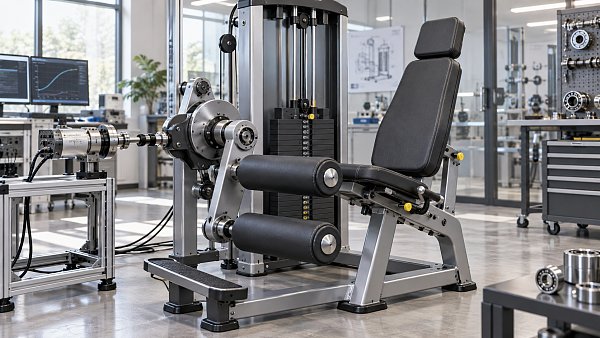
For a knee extension machine, the rotational axis should be assessed relative to the user’s knee region across seat adjustments and practical body sizes. If the seat position causes the knee to sit too far ahead of or behind the pivot, the user may feel pressure behind the knee, unwanted movement against the pad, or difficulty maintaining contact with the backrest. The same principle applies to elbow-flexion equipment, hip machines, shoulder presses, and seated presses.
- Measure the relative location of the user support surfaces and machine axis.
- Check the alignment at more than one adjustment setting, not only the mid-range position.
- Observe whether the body shifts noticeably as the arm or leg travels through the motion.
- Inspect for contact pressure points caused by pads, rollers, guards, or handle mounts.
Reach distances and starting positions
A poor starting position can make an otherwise acceptable movement unsuitable for many users. Handles positioned too far forward may pull the shoulder blades away from the back pad before resistance begins. Foot supports placed too far away may force users to lock the knees or lean forward to initiate the exercise. On cardio equipment, an overly long stride or handle reach can encourage trunk rotation and unstable stepping.
Suppliers should test the entry, setup, and exit phases as carefully as the main repetition. Users often experience awkward loading when sitting down, stepping onto a moving belt, adjusting a seat, or returning a weighted lever to its rest position. These are not secondary details; they are part of the machine’s actual use cycle.
Evaluate the resistance path, not just the maximum load
Resistance should challenge the intended muscles without creating unexpected peaks that users cannot control. The load felt by the user depends on more than a weight stack or motor rating. Lever length, cable routing, cam profile, pulley arrangement, friction, spring force, magnetic braking, belt tension, and moving mass can all change the force curve.
On a plate-loaded machine, the external load may appear simple, yet the effective moment at the user’s joint can vary sharply as the lever rotates. On cable equipment, pulley ratios and cable angles can alter both the magnitude and direction of resistance. On an exercise bike, resistance changes should remain controlled through cadence variation and adjustment transitions. A treadmill requires attention to acceleration, deceleration, incline response, and belt consistency, especially where a user may be holding rails or changing pace.
A useful verification review asks three questions:
- Does the resistance begin at a manageable level from the intended start position?
- Does it rise, fall, or remain stable in a way that matches the exercise purpose?
- Does the user lose control near either end of the range because of a sudden change in leverage, motor behavior, or return force?
Measurements can be taken with force gauges, load cells, torque tools, or instrumented test setups, depending on the equipment type. The goal is not to produce an impressive number in isolation. It is to compare the actual resistance profile against the design intent and identify discontinuities, excessive friction, asymmetric left-right behavior, or unexpectedly high return forces.
Use motion analysis to find compensation patterns
Visual inspection is valuable, but it can miss small shifts that become significant under repeated use. Video capture from the side, front, and rear can reveal whether a user’s knees collapse inward, shoulders elevate, pelvis lifts from the seat, wrists bend excessively, or feet lose stable contact. Slow-motion review is especially useful for equipment with moving linkages, fast belt motion, or changing resistance.
More detailed assessment may use marker-based systems, wearable motion sensors, pressure mapping, or force platforms where the development program requires them. These tools are helpful when a supplier needs to compare prototypes, investigate a complaint pattern, or validate a complex movement path. They should support engineering judgement rather than replace it. A technically precise motion trace still needs to be interpreted in the context of user posture, adjustment range, and exercise intent.
Look for compensations that suggest the machine is asking the body to solve a geometry problem. Examples include:
- Users lifting the hips from a seat to complete the final part of a press.
- Repeated shoulder shrugging because handles begin too high or too far forward.
- Wrist extension caused by a handle angle that does not follow the line of force.
- Foot migration on a pedal or platform because surface angle and resistance direction are mismatched.
- Trunk twisting on a unilateral machine that should permit controlled bilateral support.
One user can adapt to an imperfect machine. A pattern seen across several users is more meaningful and should trigger a design review.
Test adjustability as a biomechanical feature
Seat height, backrest position, arm length, pedal straps, handle location, roller-pad height, and footplate settings are often treated as convenience features. In practice, they determine whether the equipment can fit different bodies without placing joints at poor angles. Verification should confirm that each adjustment produces a useful change and remains secure under use.
It is not enough to provide many adjustment positions. Their travel range, increment spacing, labeling, and accessibility all matter. A seat adjustment that requires users to support a heavy moving assembly may be difficult to set correctly. A pin that is hard to see or engage can lead to partial locking. A change that moves the user away from one problem but creates another, such as reducing knee flexion while making handles unreachable, does not solve the fit issue.
Do not separate biomechanics from safety and durability
A machine can have a well-designed motion path in an early prototype but lose that quality when components wear, loosen, or vary in production. Bearing play can change lever tracking. Cable stretch can alter starting positions. Uneven padding can shift the user’s body. A motor-control issue can make acceleration feel abrupt. These effects connect product durability directly to biomechanical performance.
Production verification should therefore include dimensional checks on critical weldments and pivots, inspection of pad thickness and firmness, cable and belt routing review, resistance calibration, and functional cycling. Where applicable, suppliers should also assess pinch points, entrapment risks, emergency stopping functions, guarding, stability, labeling, and instructions against the safety requirements relevant to the destination market. Compliance testing and biomechanical validation are related but not interchangeable: a machine may meet a structural requirement while still offering a poor movement experience.
Build a repeatable verification record
Buyer reviews are easier when a supplier can show how design decisions were evaluated. The record does not need to disclose proprietary engineering details, but it should be organized enough to demonstrate control over the process. Useful documentation may include intended-use definitions, critical dimensions, adjustment ranges, resistance specifications, prototype observations, identified issues, design revisions, inspection criteria, and final functional test records.
Photographs and short motion clips can be useful internally when they clearly show setup positions and movement paths. Revision control is important. When a handle is changed, a seat rail is shortened, or a new resistance component is introduced, the earlier biomechanical assessment should not be assumed to remain valid.
Questions suppliers often raise during design review
Is user comfort enough to prove that the biomechanics are correct?
No. Comfort is an important signal, but it is subjective and can be influenced by padding, familiarity, and fitness level. Verification should combine user feedback with observable posture, joint alignment, movement consistency, and resistance behavior.
How many users should test a prototype?
The purpose of the test matters more than a fixed number. Early reviews can identify obvious geometry faults with a small, varied group. Before release, testing should include representative body sizes and experience levels within the intended user population. Repeated patterns deserve more attention than a single personal preference.
Can a machine be biomechanically sound if it has limited adjustability?
Yes, when its intended user range is narrow and the fixed geometry genuinely fits that range. However, equipment intended for shared commercial settings usually needs enough adjustment to avoid excluding users or forcing compensatory posture.
When should a supplier involve specialist support?
Specialist biomechanical, ergonomic, or clinical input is particularly useful for rehabilitation-oriented products, equipment intended for older users, unusual movement mechanisms, injury-related complaints, or designs where motion analysis reveals persistent joint or posture concerns. It is also appropriate when safety requirements require interpretation beyond routine factory inspection.

The Archive Newsletter
Critical industrial intelligence delivered every Tuesday. Peer-reviewed summaries of the week's most impactful logistics and market shifts.