Monday, May 22, 2024

Which Failure Points Should Suppliers Test in Strength Equipment?
Start With the Failures That Can Injure Users or Disable the Machine
Suppliers should test strength equipment at the points where load, motion, adjustment, and repeated human contact meet. For commercial machines, the most consequential failures are rarely cosmetic. A cracked weld, a cable that jumps a pulley, a seat adjustment that slips, or a loose fastener can take a unit out of service immediately and may create a user-safety incident.
The appropriate test plan depends on the machine category, expected user profile, installed environment, and rated resistance. A plate-loaded leg press, selectorized cable machine, power rack, and adjustable bench do not fail in the same way. Yet suppliers evaluating any of them should concentrate first on structural load paths, moving assemblies, retention systems, and components that users touch or adjust repeatedly.
A useful rule is to test a failure point under the combination of forces it will actually see: static load, repeated cycling, off-axis loading, impact at the end of travel, and misuse that is reasonably foreseeable. A component that survives a single proof-load test can still wear prematurely when vibration, misalignment, sweat exposure, and thousands of repetitions are added.
Frame, Weld, and Joint Failures Deserve the First Review
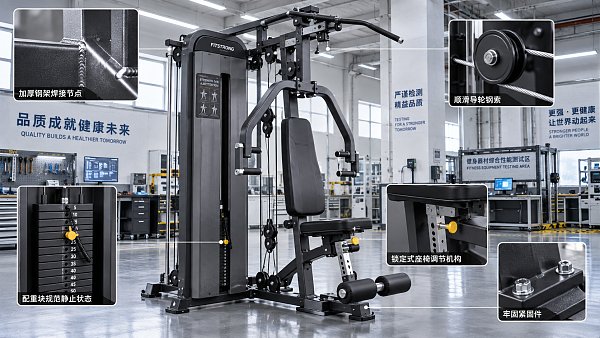
The frame carries the machine's primary load, but its risk is concentrated at transitions rather than spread evenly across every tube. Suppliers should inspect and test welded intersections, upright-to-base connections, weight-horn supports, rack hooks, pivot brackets, and areas around drilled holes or welded tabs. These locations can experience local stress concentration even when the main frame looks oversized.
Static capacity testing establishes whether the structure can support its stated load with an appropriate margin. It should not be the only structural check. Fatigue testing is needed where users repeatedly apply force through the same pathway: a press arm pivot, a squat stand catch, a cable tower frame, or a leg machine lever. Repeated loading can initiate cracking at a weld toe, heat-affected zone, sharp bracket corner, or poorly supported attachment point long before visible permanent deformation occurs.
Off-center loading matters especially for free-weight equipment. Users do not always rack a bar evenly, load plates symmetrically, or lower resistance in a controlled line. A rack or stand that performs well under centered vertical load may twist under uneven loading. Test conditions should therefore include realistic eccentric loads and the combined effect of a loaded bar, side movement, and repeated re-racking impact.
Suppliers should also check whether the base remains stable when the machine is used as intended. Stability is influenced by footprint, center of mass, floor contact, user position, resistance level, and the direction of applied force. A structurally strong machine can still be unsuitable if it rocks, migrates across the floor, or lifts at one corner during normal exercise.
Moving Load Paths Often Create the Most Expensive Warranty Problems
Cable-based equipment deserves a dedicated failure-mode review because its load travels through several components. The cable, termination, pulley, bearing or bushing, pulley bracket, guide rod system, selector pin, and weight stack all have to remain aligned. A defect in one part can accelerate failure elsewhere.
Cable testing should cover more than rated tensile strength. Suppliers should examine bending fatigue over pulleys, strand damage near end fittings, abrasion against guards or frame edges, corrosion resistance where sweat or humid air is expected, and cable tracking throughout the full range of motion. A cable that lightly rubs an edge on every repetition may appear acceptable at final inspection but become a field failure after a relatively short service interval.
Pulley alignment is equally important. Misalignment can cause side loading, noise, accelerated groove wear, cable fraying, and a change in resistance feel. It may arise from loose brackets, poor assembly tolerances, distorted sheet-metal guards, or frame movement under load. Test the cable path at minimum and maximum resistance, through the full travel range, and after cycling. Inspection only at rest will not reveal every tracking problem.
On selectorized machines, the selector pin and weight-stack engagement mechanism require close attention. The pin must fully engage, remain retained during exercise, and resist damage from repeated insertion. The stack should travel smoothly without plate binding, guide-rod scoring, excessive lateral movement, or collisions that create sharp shock loads. If the top plate or selector mechanism has enough play to rattle excessively, the machine may still operate but will project poor quality and can develop wear at a faster rate.
Plate-loaded equipment has fewer cables but is not mechanically simple. Weight horns, plate stops, leverage arms, pivot axles, and handle assemblies all carry repeated loads. The test plan should include the impact created when a user drops the lever arm near the end of travel or allows plates to settle abruptly. End-stop materials and their mounting points are common weak locations because they absorb concentrated energy repeatedly.
Adjustment Systems Must Hold Position Under Use, Not Just When Unloaded
Seats, back pads, rollers, lever arms, J-hooks, safety catches, and telescoping columns are often judged by ease of adjustment during a showroom review. Their safety function is more important. Once locked, they must stay locked under the intended load and through the directional forces generated by exercise.
Suppliers should test adjustment mechanisms at every available position, not only in the middle of the adjustment range. The end positions can have less engagement, different leverage, or greater exposure to manufacturing variation. Test for pin engagement depth, tooth or ladder engagement, locking-handle retention, unwanted release, excessive clearance, and deformation after repeated adjustments.
For benches and racks, the consequences of a slip can be severe. A back pad that drops a notch under a loaded user, or a safety arm that moves after being set, is not a minor fit-and-finish problem. These components need both load testing and cycle testing, with checks for wear that gradually reduces engagement. Paint thickness, burrs, weld spatter, or inconsistent hole geometry can affect the fit of a locking pin and should be treated as functional quality issues.
Gas springs, where used for assisted adjustment, should be evaluated for controlled movement, retention, leakage, mounting security, and behavior across the expected operating environment. They should not be assumed to provide the primary safety lock unless the design and intended standard explicitly allow it. A positive mechanical locking system is generally easier to inspect and less dependent on seal condition over time.
Fasteners and Pivots Need a Vibration and Wear Strategy
Fastener loosening is one of the most preventable failure modes in strength equipment. It can lead to noise, instability, misalignment, guard interference, and eventual structural damage. The risk is higher at pivots, handle assemblies, cable brackets, seat mechanisms, and joints exposed to alternating force.
A supplier's validation plan should define the fastening method, torque specification, washer arrangement, thread engagement, locking feature, and inspection method for each safety-relevant connection. Testing should then verify that the joint retains its function after repeated loading. Simply confirming that bolts were tightened at assembly does not show whether the connection will remain secure after transport vibration and extensive use.
Pivot points deserve the same discipline. A pivot can fail through axle bending, bearing seizure, bushing wear, retaining hardware loss, or increasing side play. Excess play changes the movement path and can transfer load into guards, cables, or frame members that were not intended to carry it. Cycle testing should include checks of smoothness, backlash, noise, visible wear debris, and dimensional drift after cycling.
- Test critical bolted joints after cyclic loading, not only at initial assembly.
- Inspect pivot retention features for accessibility and correct installation.
- Measure play at moving joints against an internally defined acceptance limit.
- Check whether lubrication, if required, can be performed without removing major assemblies.
- Verify that covers and guards remain secure after vibration and repeated machine use.
User-Contact Parts Can Become Safety Failures
Handles, grips, upholstery, foot platforms, rollers, and adjustment levers are sometimes treated as secondary components because they do not form the main frame. In practice, their deterioration changes how users control the machine. A loose handle, torn pad, slippery footplate, or cracked roller can lead to poor positioning and unexpected force transfer.
Grip assemblies should be tested for pull-off resistance, rotational movement, surface wear, and resistance to sweat, cleaning products, and repeated contact. A foam grip may look acceptable at shipment yet split, loosen, or become difficult to clean in a commercial facility. If the grip is bonded, the adhesive process and surface preparation are as relevant as the material selection. If it is mechanically retained, the retaining design should be inspected for sharp edges and long-term security.
Upholstered pads need checks for seam strength, substrate cracking, compression set, staple or fastener retention, and cover resistance to the cleaning routine expected in the destination market. Foam density alone does not establish durability. The pad structure, backing board, edge geometry, and attachment to the adjustment frame all contribute to service life.
Footplates and platforms should maintain traction when exposed to sweat and ordinary cleaning residue. Their edges, welds, and fasteners should not create snag points. On machines where a foot platform is part of the load path, test both the surface and the supporting bracket; a sound tread pattern does little good if the platform flexes excessively or its attachment loosens.
Test the Machine as an Assembly, Not as a Collection of Passed Parts
Component certificates and supplier test reports are useful inputs, but they do not replace finished-machine validation. Assembly variation can change cable routing, bolt preload, pulley alignment, pad position, and stability. Packaging and transport can also introduce damage or loosening before the equipment reaches the installer.
For that reason, the most effective quality plan has several layers. Incoming inspection verifies safety-relevant purchased parts. In-process controls check welding, dimensions, torque, cable routing, and adjustment function. Finished-unit testing confirms smooth operation, stability, correct labeling, guarding, and the absence of interference through the full range of motion. Periodic audit testing then subjects production units to more demanding load and cycle evaluation.
Ask for Evidence That Matches the Equipment's Intended Use
Buyers should be cautious when suppliers offer a generic statement that a machine is “load tested” without defining the load case, test duration, acceptance criteria, or unit configuration. A meaningful discussion separates proof testing from fatigue testing, and laboratory evaluation from production control. It also identifies whether the test was performed on the exact model, including the intended cable, fasteners, adjustment mechanism, and resistance system.
Where a destination market or project specification requires a particular safety standard, suppliers should map the product design and test documentation to that requirement rather than rely on a broad claim of compliance. The applicable requirements can vary by equipment type and market. Product instructions, warning labels, installation requirements, maintenance intervals, and maximum-user or maximum-load statements should be consistent with the configuration that was tested.
For commercial purchasers, the best question is often: what will fail first if this machine is used repeatedly, adjusted frequently, and maintained imperfectly? A supplier that can identify those points, explain the test method, and show how production controls prevent recurrence is usually providing more useful assurance than one that presents only a finished-product appearance or a high headline load rating.
Strength equipment reliability is built around failure paths, not isolated specifications. Start with structural joints and load retention, follow the motion and cable path through the machine, then examine the adjustment and contact components that shape real user behavior. That sequence gives suppliers a practical testing priority and gives buyers a clearer basis for comparing equipment that may look similar on a sales floor but carry very different long-term risk.

The Archive Newsletter
Critical industrial intelligence delivered every Tuesday. Peer-reviewed summaries of the week's most impactful logistics and market shifts.