Monday, May 22, 2024

What Should a Fitness Equipment Supplier Audit Cover Before Ordering?
A polished catalog and an attractive quotation can make a fitness equipment supplier look ready for business. Yet commercial treadmills, exercise bikes, strength machines, and connected training systems are not simple commodities. They combine moving parts, load-bearing structures, electronics, software, safety requirements, and long-term service expectations. A weakness in any one area can become a costly issue after equipment reaches a gym floor, hotel, school, rehabilitation center, or retail warehouse.
So, what should a fitness equipment supplier audit include before ordering? It should verify far more than whether the factory exists and can offer a competitive price. Buyers need evidence that the supplier can consistently build safe products, control critical components, meet applicable compliance obligations, manage production peaks, and provide useful support when something fails in the field.
The audit does not need to be punitive. A well-run review gives both parties a shared picture of product requirements, production risks, and responsibilities before a bulk purchase makes changes expensive.
Start with the equipment and the intended market
An audit should be designed around the actual buying scenario. The risks for a home-use folding treadmill are different from those of a full commercial treadmill expected to run all day. Likewise, a selectorized strength machine for a hotel gym has different service and installation demands from a compact exercise bike sold through cross-border e-commerce.
Before examining the supplier, document what the equipment must do and where it will be sold. Define the user category, expected duty cycle, maximum user weight where relevant, installation environment, packaging format, branding requirements, target retail price position, and destination markets. This framing determines which evidence matters most.
- For commercial equipment, prioritize frame durability, motor thermal management, service access, wear-part availability, and preventive maintenance guidance.
- For connected fitness products, include data privacy considerations, app compatibility, firmware update control, and the stability of displays, sensors, and heart-rate functions.
- For institutional buyers, examine accessibility needs, user instructions, anchoring requirements, and documentation for facility operators.
- For retail and e-commerce programs, look closely at packaging drop resistance, assembly clarity, spare-parts fulfillment, and return handling.
A supplier can be capable in one segment without being suitable for another. A factory experienced in light home fitness equipment may not have the engineering validation, welding consistency, or after-sales structure required for a demanding commercial fleet.
Confirm the supplier’s identity, manufacturing role, and accountability
One of the first questions is deceptively simple: who actually makes the product? Some companies own their production lines, while others coordinate a network of subcontractors. Neither model is automatically unacceptable, but the buyer must understand where responsibility sits.
The audit should confirm the legal entity, manufacturing address, business scope, key management contacts, export experience, and ownership or control of the factory. Review whether the supplier is acting as a manufacturer, trading company, brand owner, or a mixture of these roles. If key processes are outsourced—such as motor assembly, powder coating, display manufacturing, foam molding, or upholstery—request a clear list of those processes and the controls applied to them.
Ask a practical question: if a recurring defect appears six months after shipment, who has the authority and resources to investigate it? A vague answer can reveal a fragile supply arrangement long before a purchase order is issued.
Walk the production flow, not just the showroom
A showroom demonstrates styling. The production floor reveals repeatability. During an on-site or third-party audit, follow a representative product from incoming material to final packing. The goal is not to criticize every imperfection; it is to see whether the factory has a disciplined way of preventing defects from moving downstream.
For fitness equipment, attention should be paid to cutting, bending, welding, machining, surface preparation, painting or powder coating, assembly, electrical installation, programming, functional testing, and packing. Each stage has its own failure points. Poor weld penetration can compromise a load-bearing frame. Inconsistent coating preparation can lead to corrosion. Loose wiring, pinched harnesses, or poorly secured connectors can cause intermittent console failures that are difficult to diagnose after delivery.
Observe whether parts are identified, whether work instructions are current at the workstation, and whether in-process checks are documented. Look for physical separation between approved and rejected materials. If workers rely entirely on memory rather than clear procedures, product consistency may depend too heavily on individual experience.
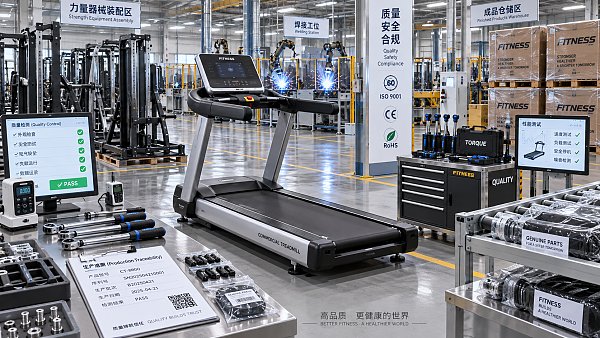
Questions worth asking on the factory floor
- How are incoming steel tubes, bearings, motors, cables, consoles, and fasteners checked against specifications?
- Are welding fixtures maintained and verified to prevent frame misalignment?
- How are torque settings controlled for pedals, cranks, handlebar assemblies, fasteners, and moving joints?
- What prevents the wrong console, motor, resistance system, or power configuration from being installed?
- How are reworked units marked, re-inspected, and released?
- Can the factory trace a finished serial number back to its production batch and major components?
Strong answers should be supported by records, samples, and visible routines—not only verbal assurances.
Examine quality control where failures are most likely
A meaningful fitness equipment supplier audit should review the quality management system in practical terms. Certification to a quality management standard can be useful context, but it is not a substitute for checking how the system operates on real products.
Review inspection plans for critical characteristics: frame geometry, weld quality, coating thickness where specified, belt tracking, roller alignment, noise level, resistance accuracy, seat adjustment stability, console responsiveness, emergency stop function, and electrical safety. For strength machines, inspect cable routing, pulley movement, selector pin engagement, weight stack alignment, and guarding around pinch points. For treadmills, test deck cushioning, belt tracking, speed stability, incline operation, motor heat behavior, and emergency-stop response.
Ask to see nonconformance reports and corrective-action records. A factory with no recorded defects is not necessarily flawless; it may simply lack an honest reporting culture. More reassuring signs include recurring-problem analysis, documented root causes, ownership of corrective actions, and evidence that improvements are checked over time.
Safety, compliance, and documentation must match the destination
Fitness equipment is used by people of different ages, body sizes, and experience levels, often without direct supervision. Safety cannot be treated as a document collected at the end of the sourcing process.
The supplier should identify the standards, regulations, labeling rules, electrical requirements, and product documentation applicable to the intended markets. Depending on the equipment type and sales region, this may include mechanical safety, electrical safety, electromagnetic compatibility, materials restrictions, user warning requirements, and test reports from appropriate laboratories. The buyer should verify that documents apply to the exact model, configuration, voltage, and production version being ordered.
Be especially careful with “certificate sharing.” A report for a visually similar treadmill does not prove compliance for a revised frame, different motor controller, larger display, altered plug, or new resistance mechanism. Product changes can affect compliance status even when the external design seems unchanged.
The audit should also cover manuals, installation instructions, maintenance schedules, warning labels, serial-number labeling, and spare-parts diagrams. Clear documentation protects end users, reduces installation errors, and gives distributors a workable basis for service.
Trace the components that determine performance
Many fitness equipment problems originate upstream. A treadmill may carry a reputable outer brand but still fail because of a low-grade bearing, unstable motor controller, inconsistent running belt, weak power supply, or poorly calibrated sensor. For this reason, component sourcing deserves its own audit section.
Identify critical suppliers and determine whether they are approved through defined criteria. The fitness equipment manufacturer should be able to explain how it validates motors, inverters, screens, springs, cables, bearings, batteries, chargers, and electronic boards. There should also be a process for handling substitutions. An unauthorized replacement made to reduce cost can quietly change noise, durability, safety, or compatibility.
Where brand-name components are specified, check purchase evidence, part markings, and incoming inspection records. Where components are proprietary or custom, request technical specifications and sample validation data. This is particularly important for smart fitness systems, where hardware and software must work together across multiple production batches.
Evaluate capacity honestly: output is more than a monthly number
Suppliers often state production capacity in broad terms. A more useful question is whether they can deliver your order, at your quality level, within the required window, while supporting other customers. Audit the number and condition of production lines, staffing stability, shift arrangements, bottleneck processes, warehouse space, and contingency plans for component shortages.
Ask for a capacity plan tied to the proposed order. It should show the key milestones: component arrival, frame fabrication, coating, assembly, testing, packaging, final inspection, and shipment release. Review how the supplier handles peak-season demand, engineering changes, and urgent spare-parts requests. Lead time should include enough room for inspection and corrective action; a schedule that leaves no recovery margin is a procurement risk, not a sign of efficiency.
Do not leave after-sales support outside the audit
Commercial fitness equipment has a long life after the container arrives. Gym operators may need replacement belts, deck boards, cables, rollers, pedals, displays, control boards, or upholstery components. Distributors need troubleshooting guidance. Retail buyers need a clear process for concealed damage and early-life failures.
Review the warranty scope, exclusions, claim process, response responsibilities, and availability of technical personnel. Ask whether the supplier maintains spare parts by model and revision, how long parts are expected to remain available, and whether manuals include exploded views and part numbers. For electronic products, clarify firmware support and whether software revisions can be controlled by serial number or batch.
A useful test is to present a realistic service scenario: a treadmill console powers on but does not communicate with the motor controller, or a strength machine cable shows abnormal wear after installation. Can the supplier explain the diagnostic path, necessary photos or measurements, likely spare parts, and expected decision process? The answer says much more than a generic promise of “good service.”
Use findings to make a buying decision, not merely to score a factory
An audit report should distinguish between critical risks, manageable gaps, and improvement opportunities. Critical concerns may include missing safety evidence, uncontrolled subcontracting, inability to trace products, weak electrical testing, or no credible support process. These should be resolved before ordering. Other findings—such as incomplete visual work instructions or limited warehouse labeling—may be addressed through corrective-action deadlines and follow-up verification.
For first orders, buyers can reduce exposure by approving a golden sample, defining inspection criteria in the purchase agreement, requiring notification of component or design changes, and scheduling pre-shipment inspection. The audit should also inform contract language on quality tolerances, packaging, documentation, spare parts, warranty responsibilities, and remedies for nonconforming goods.
Frequently asked questions
Is a remote supplier audit enough before ordering fitness equipment?
A remote audit can be a sensible early-stage tool, especially when travel is impractical. Video walkthroughs, document review, live demonstrations, and interviews can reveal important information. However, for high-value orders, new suppliers, commercial equipment, or safety-sensitive products, an on-site visit or qualified third-party inspection offers stronger verification of production conditions and actual controls.
How often should a fitness equipment supplier be audited?
Audit timing depends on order value, product complexity, supplier history, and changes in production. A full pre-qualification audit is common before the first significant order. Follow-up reviews are valuable when the supplier changes facilities, introduces a new model, shifts critical components, experiences repeated quality claims, or begins serving a more demanding market segment.
What is the biggest mistake buyers make?
Relying on price, samples, and certificates alone. A sample may be hand-finished, and a certificate may not cover the final configuration. The more reliable approach is to connect the approved sample to a controlled bill of materials, production process, testing plan, and inspection standard.
Ultimately, the best supplier audit creates confidence based on evidence. It shows whether the manufacturer can turn a design specification into safe, durable, serviceable fitness equipment repeatedly—not just once for a presentation. That distinction is what protects a procurement team’s budget, a distributor’s reputation, and the end user’s training experience.
The Archive Newsletter
Critical industrial intelligence delivered every Tuesday. Peer-reviewed summaries of the week's most impactful logistics and market shifts.