Monday, May 22, 2024

Which Safety Checks Matter Most for Extreme Sports Equipment?
For extreme sports equipment, the safety checks that matter most are the ones tied to how the product fails under load, impact, motion, weather, and repeated use. A helmet can look well finished and still provide poor protection if its shell, liner, retention system, or fit has not been evaluated as a working system. A climbing harness may use strong webbing but remain unsafe if stitching, buckles, or load-bearing attachment points perform inconsistently after abrasion or moisture exposure.
Manufacturers, buyers, and compliance teams should therefore rank checks by injury consequence. Structural integrity, impact management, secure retention, material durability, and fit are usually more important than cosmetic finish, accessory count, or broad marketing claims. The exact test program will differ for downhill cycling, climbing, skateboarding, skiing, motocross, water sports, or aerial activities, but the underlying question stays the same: can this equipment keep performing when the user is moving fast, falls hard, or depends on it as a primary safety barrier?
Start with the failure mode, not the product category
The most useful safety review begins by identifying what could happen when the equipment fails. Extreme sports products are often exposed to combinations of force that ordinary recreational goods do not face: sudden impact, twisting, repeated loading, sharp-edge contact, vibration, wet conditions, ultraviolet exposure, mud, salt, heat, cold, and user error.
That makes a generic “quality inspection” insufficient. A helmet, knee guard, harness, rope, carabiner, wakeboard binding, downhill bike component, or protective jacket should be assessed against the conditions that create the highest plausible injury risk.
- For helmets, the leading concern is whether the assembly can manage impact energy while staying securely positioned on the head.
- For harnesses, lanyards, anchors, and connectors, the priority is load capacity, fatigue resistance, buckle security, and visible damage detection.
- For body armor, impact attenuation, coverage, attachment stability, and freedom of movement need to work together.
- For boards, bikes, skis, bindings, and similar equipment, structural failure, unintended release, sharp fracture surfaces, and loss of control are more relevant than surface appearance.
A buyer should ask suppliers to explain the anticipated failure modes before asking for a test report. This reveals whether the product has been engineered around actual use or simply built around a familiar visual format. A report is valuable only when its test method, product configuration, sample selection, and claimed application match the item being purchased.
Structural strength and fatigue resistance come first for load-bearing gear
Load-bearing equipment deserves the most demanding scrutiny because a single break can lead directly to a fall, collision, or loss of restraint. Static strength testing confirms whether a component can resist a defined load at a particular moment. It is necessary, but it does not answer whether the same component will remain reliable after hundreds or thousands of load cycles.
For harnesses, straps, buckles, ropes, connectors, bindings, and frame assemblies, review both ultimate strength and fatigue behavior. Repeated loading can loosen stitching, deform hardware, create cracks around molded inserts, weaken bonded joints, or expose poor reinforcement around stress concentrations. Components may pass an initial pull test while still degrading prematurely in field use.
Attention should focus on transitions: where webbing enters a buckle, where a metal insert meets a polymer shell, where a strap is sewn into a load loop, where a bolt passes through a composite structure, or where a binding connects to a board. These interfaces are common sites for wear and stress concentration.
It is also important to distinguish between the capacity of a raw material and the capacity of the finished assembly. High-tensile webbing, aluminum hardware, carbon fiber, or reinforced polymer does not guarantee a safe end product. Pattern design, stitching density, heat treatment, molding consistency, fastener torque, and assembly control all affect real performance.
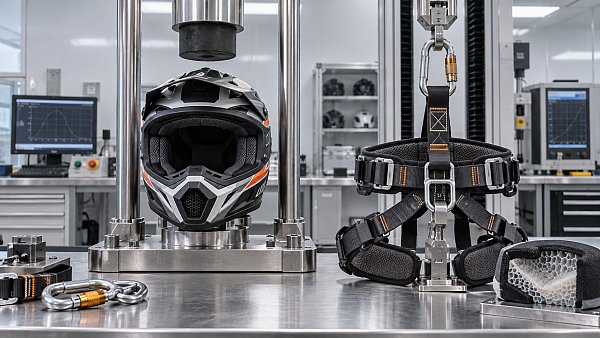
Impact protection must be checked as a system
Impact protection is often reduced to a simple question: how thick is the foam or shell? Thickness alone is a weak purchasing criterion. Protective performance depends on the material combination, density profile, shape, ventilation openings, shell geometry, attachment method, and the way the product remains in place during an incident.
For helmets, check the shell and energy-absorbing liner for consistency across the full protected area, including areas near vents, edges, and mounting features. A mounted visor, camera bracket, adjustment dial, or removable liner can affect performance if it changes shell behavior or creates snagging and breakaway concerns. The product should be reviewed in its retail configuration, not only as a bare shell.
Body protection requires a similar approach. Pads should remain aligned with the intended body area through bending, riding, jumping, or sliding. A protector that shifts away from the knee, elbow, shoulder, spine, or chest at the point of impact may offer less practical protection than laboratory material data suggests. Retention straps must keep the guard in place without creating pressure points that cause users to loosen or remove it.
Impact checks should also consider temperature. Some polymers and foam systems become stiffer, more brittle, softer, or less stable outside a moderate indoor environment. Equipment intended for alpine, desert, high-altitude, or water-based use needs performance expectations suited to those conditions. Suppliers should be able to identify any environmental limits, storage requirements, and replacement guidance associated with the protective materials.
Retention, fastening, and fit are safety functions
Many preventable equipment failures occur because the product is not retained correctly. A helmet that rotates during a crash, a harness that is poorly adjusted, or a binding that releases unpredictably can turn an otherwise sound product into a high-risk one.
Retention-system checks should cover more than whether a buckle clicks shut. Examine adjustment range, strap routing, buckle lock engagement, resistance to unintended opening, compatibility with gloves, and the possibility of webbing slip after repeated tightening. For helmets, assess chin strap security, anchor-point construction, rear adjustment mechanisms, and whether the wearer can achieve a stable fit without excessive pressure.
Fit is especially important for products sold across borders. Head shape, body proportions, clothing layers, footwear, and typical user practices vary by market and sport. A nominal size range can conceal poor coverage or an adjustment system that does not accommodate the intended user population. Buyers should request clear sizing specifications, fitting instructions, and samples across relevant sizes rather than approving only one reference sample.
Fit reviews should include foreseeable use conditions. Ski and snow sports helmets may be worn with goggles and cold-weather layers. Mountain bike helmets may be used with eyewear, hydration packs, and communication accessories. Climbing harnesses must function across different clothing thicknesses. A product that appears secure in a static fitting session can become unstable when users sweat, move repeatedly, or wear the equipment with standard sport-specific accessories.
Material durability is a safety issue, not a cosmetic concern
Extreme sports equipment often spends substantial time in storage, vehicles, damp environments, direct sunlight, or contact with dirt and chemicals. These exposures can degrade materials long before visible failure appears. Safety checks should examine the effects of ultraviolet light, moisture, salt, sweat, cleaning agents, oils, temperature cycling, abrasion, and corrosion where relevant.
Polymer components require close attention because color, surface texture, and initial rigidity may remain acceptable while internal aging reduces toughness. Webbing and stitching can be weakened by abrasion, contamination, or prolonged ultraviolet exposure. Metal components can corrode, seize, or develop surface damage that compromises smooth operation. Composite structures can accumulate hidden damage after impacts, especially near drilled holes, edges, or bonded areas.
This is why durable equipment should come with meaningful care, inspection, storage, and retirement instructions. These are not secondary documents. They help users recognize when a product can no longer be treated as protective equipment. Buyers evaluating private-label or imported goods should check that instructions match the actual materials and intended environment, rather than relying on generic language copied across unrelated products.
Product consistency matters as much as a passing sample
A prototype or pre-production sample can perform well while later production varies in critical ways. The safety question for B2B purchasers is therefore not only “Did this sample pass?” but “Can the supplier repeatedly make this same safety-critical configuration?”
Supplier evaluation should examine controls over incoming materials, traceability, assembly steps, inspection records, and engineering changes. A replacement buckle, different foam supplier, altered stitching pattern, revised mold, or new adhesive can materially change product behavior. Such changes should trigger a documented review before the revised product is shipped under an existing approval or certification claim.
For high-risk equipment, samples should represent actual production processes, finishes, hardware, and packaging. Packaging can matter when it causes strap deformation, compression of foam components, moisture exposure, or incomplete instructions. Batch identification is also useful because it supports targeted corrective action if a defect is discovered after distribution.
Questions buyers should ask before approval
- What failure modes was this product designed and tested to address?
- Which finished-product tests apply to this exact model, size range, and configuration?
- What components are safety-critical, and how are they controlled during production?
- What happens if a key material, supplier, mold, buckle, or assembly process changes?
- How is lot traceability maintained from production through shipment?
- What inspection, cleaning, storage, and replacement instructions are supplied to end users?
Compliance documentation should support the technical review, not replace it
Applicable regulations and voluntary standards vary by product, market, sport, and intended user. A test report or certification document can be important evidence, but it should be read with the same care given to the physical sample. Confirm the product name, model, component configuration, size coverage, test method, issuing organization, and validity of the documentation. A certificate associated with a similar-looking item may not cover a modified version, an accessory-equipped version, or a different production site.
Claims also need to be specific. “Tested,” “certified,” “impact resistant,” and “professional grade” do not carry equal meaning. The stronger question is whether the claim can be tied to an identifiable product requirement and a documented evaluation process. This protects distributors and retailers from presenting safety features more broadly than the evidence supports.
Compliance review is particularly important when equipment serves multiple uses. A helmet designed for one form of riding may not be appropriate for another activity with different impact conditions. A protective pad suitable for low-speed skating may not provide the same protection in motocross or downhill mountain biking. Product labeling, instructions, and sales content should state the intended use clearly enough to limit foreseeable misuse.
How to prioritize checks when time is limited
When procurement timelines are tight, prioritize the checks associated with severe and irreversible outcomes. First examine whether load-bearing parts, shells, impact liners, straps, buckles, connectors, and attachment points are structurally sound. Then confirm retention and fit across the target size range. After that, review durability under the environmental exposures most likely for the sport and market.
Visual finish, packaging presentation, branding, and feature differentiation still affect commercial success, but they should not compete with the core safety gate. A well-designed safety review gives the product team a clearer basis for deciding whether to approve, revise, restrict, or reject a design before it reaches users.
The most dependable extreme sports equipment is rarely defined by one impressive material or one passing test. It is defined by a coherent set of controls: realistic hazard assessment, appropriately targeted testing, secure fit, durable materials, stable manufacturing, and instructions that help users keep the equipment within its safe service life.
The Archive Newsletter
Critical industrial intelligence delivered every Tuesday. Peer-reviewed summaries of the week's most impactful logistics and market shifts.