Monday, May 22, 2024

What Material Tests Are Required for Carbon Fiber Sports Products?
A carbon fiber bicycle frame that feels exceptionally stiff in the showroom can still fail the moment that matters most: after thousands of road vibrations, a curb strike, repeated sprint loads, or prolonged exposure to heat and moisture. The same concern applies to rackets, paddles, helmets, ski poles, wheel rims, protective guards, and other sports products made from fiber-reinforced composites.
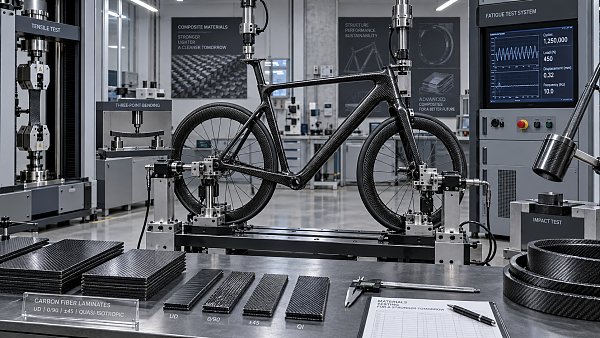
The direct answer to what material tests are needed for carbon fiber sports products is that a single strength test is not enough. A suitable program normally combines coupon-level tests for tensile, compression, flexural, shear, impact, and fatigue behavior with product-level evaluation of joints, laminate quality, environmental resistance, and realistic service loads. The final test selection should reflect the product’s geometry, expected impacts, user weight or force, loading direction, and the consequences of failure.
Start with the actual failure risk, not just the material label
“Carbon fiber” describes the reinforcement, but a sports component is a composite system. Its performance depends on the fiber type, fiber orientation, resin system, lay-up sequence, wall thickness, core material where used, curing process, bonded inserts, paint layers, and manufacturing consistency. A unidirectional laminate can be extremely strong along the fiber direction while being more vulnerable to transverse cracking, delamination, or crushing in another direction.
This is why a buyer should not accept a generic statement such as “high-strength carbon fiber tested for durability” without asking what was tested. A tensile result from a flat coupon may confirm part of the laminate’s capability, but it does not establish resistance to a dropped racket, a pedal strike on a crank area, a wheel rim impact, or a handlebar clamp load. Testing must follow the likely damage mechanism.
Mechanical tests that establish the laminate baseline
Material characterization usually begins with representative laminate coupons. These specimens should be manufactured from the same resin, fiber architecture, cure cycle, and nominal lay-up used in the product whenever possible. Testing a supplier’s generic prepreg sheet may be useful for screening, but it is not a substitute for verifying the production laminate.
Tensile testing
Tensile testing measures how the laminate behaves when pulled apart. It can provide tensile strength, tensile modulus, strain to failure, and the nature of the fracture. For carbon sports products, testing should consider both the main fiber direction and off-axis directions where relevant. The main direction often governs stiffness and peak pulling loads, while transverse and angled directions reveal how well the matrix and fiber architecture support multidirectional use.
For example, a carbon shaft, paddle face, or frame tube may carry high axial loads, but it also experiences twisting and local stresses around holes, transitions, or attachments. A strong longitudinal tensile result should therefore be read alongside shear and compression data rather than treated as a complete quality verdict.
Compression and flexural testing
Compression testing is especially important because carbon composites can fail differently under compression than under tension. Fiber microbuckling, matrix cracking, local wrinkling, or instability near geometric transitions can limit usable compressive strength. Components such as bike frames, ski poles, hockey sticks, oars, and protective structures may see compression during landing, bracing, braking, or bending.
Flexural testing evaluates bending behavior. It is useful when a part is designed to flex, such as a racket frame, a bicycle fork, a pole, a board component, or a leaf-like suspension element. The test can reveal stiffness, bending strength, and whether failure starts on the compression face, tension face, or at an interface. However, a simple flexural coupon does not duplicate a full product with curved sections, variable thickness, cutouts, or bonded hardware. It should be treated as a material-screening tool and paired with structural testing.
Interlaminar shear and fracture toughness
Delamination is one of the most important composite-specific risks. It occurs when layers separate internally, sometimes after an impact that leaves only a small surface mark. Interlaminar shear testing helps assess the bonding between plies, while fracture-toughness testing can help characterize resistance to crack growth under opening or sliding forces.
These tests become more important when a product has thick laminate sections, abrupt ply drops, complex curves, sandwich construction, drilled holes, or high local loads. A component may retain some stiffness after internal damage, so visual inspection alone is not always enough to determine whether it remains safe for use.
Impact testing should reflect the sporting environment
Impact resistance is frequently misunderstood. Carbon composites are not evaluated in the same way as ductile metals because their damage can be localized and internal. A hard object strike may produce fiber breakage, matrix cracking, crushed core, or delamination without obvious bending.
A practical test plan often includes controlled low-energy impact testing for foreseeable knocks and drops, followed by residual-strength or residual-stiffness evaluation. The key question is not only “Did the sample break at impact?” but also “How much load can it safely carry after the impact?” This is particularly relevant for bicycle rims and frames, helmets, paddles, rackets, hockey sticks, skis, and carbon protective equipment.
The impact location matters as much as the impact energy. Testing should focus on vulnerable zones: tube junctions, edges, corners, handle interfaces, rim bead areas, fastener locations, seat or saddle regions, and bonded inserts. Flat center sections are often easier to test but may not represent the real weak point.
Fatigue testing answers the question a static test cannot
Sports products are rarely loaded once. They are cycled through pedaling, striking, landing, bending, vibration, torsion, and repeated grip forces. Fatigue testing evaluates how a carbon composite or finished component performs under repeated loading below its immediate breaking load.
A good fatigue program identifies the load mode that dominates normal use. A bicycle crank or frame area may require repeated bending and torsion. A tennis racket may need repeated impact and frame deflection. A ski pole or paddle shaft may need cyclic bending. A carbon plate used in footwear may need repeated flexing under changing temperature and moisture conditions.
During fatigue tests, teams should monitor more than final breakage. Changes in stiffness, permanent deformation, audible cracking, heat buildup, crack initiation, and visible finish damage can indicate progression toward failure. Post-fatigue inspection is also useful because a product may pass a cycle count while developing damage around joints or inserts that requires closer assessment.
Bonded joints, inserts, and drilled areas need their own validation
Many carbon fiber sports products are not one-piece laminates. They contain aluminum or steel inserts, threaded sleeves, molded fittings, foam or honeycomb cores, grip assemblies, bonded shells, or mechanical fasteners. These interfaces often determine real-world reliability.
Relevant testing may include pull-out, push-out, torque, peel, lap-shear, bearing, and clamp-load evaluation. The right method depends on how the connection works. A threaded insert should be assessed for torque retention and resistance to pull-out. A bonded handle should be checked for peel and torsional loads. A clamped tube should be evaluated for local crushing and crack initiation at the contact point.
Fastener holes deserve attention because drilling interrupts fibers and introduces stress concentration. The laminate around a hole should have sufficient bearing strength and reinforcement for the intended load. Simply increasing fastener torque can create a new failure mode by crushing the laminate or damaging the resin-rich surface.
Environmental conditioning prevents misleading “dry lab” results
A composite that performs well immediately after manufacture may behave differently after exposure to water, sweat, salt, ultraviolet light, heat, freezing conditions, cleaning agents, or repeated temperature changes. The resin matrix, adhesive layers, coatings, and interfaces are typically more environmentally sensitive than the carbon fibers themselves.
Environmental testing should be connected to the product’s intended setting. Outdoor cycling and watersports equipment may require moisture, salt exposure, and ultraviolet assessment. Winter sports products may require cold-condition impact or flex testing. Fitness equipment used in warm indoor environments may need sweat and cleaning-chemical compatibility around grips, coatings, and joints.
Conditioned samples should normally be retested mechanically, not merely examined visually. A surface may still look acceptable while bonded joints lose strength or moisture affects matrix-dominated properties. Thermal cycling can be useful where carbon composite parts are joined to metal components, since different materials expand and contract at different rates.
Production quality checks are part of material verification
Mechanical properties can vary when the manufacturing process changes. Voids, dry fiber areas, resin-rich pockets, poor consolidation, incorrect fiber orientation, cure deviations, trapped air, and inconsistent wall thickness can reduce performance. The highest-risk defect is not always visible after paint or clear coating is applied.
For this reason, manufacturers commonly combine destructive testing of representative coupons or sacrificial parts with non-destructive inspection methods appropriate to the product. Visual checks can identify surface defects, wrinkles, exposed fibers, and finish irregularities. Tap testing may help locate some delaminated zones in certain structures. Ultrasonic methods can provide deeper information for suitable geometries, while radiographic or other specialist methods may be considered when internal features and criticality justify them.
Inspection alone does not prove structural strength, and a mechanical test alone does not prove every production part is free of defects. The useful approach is to connect incoming material controls, process records, dimensional checks, non-destructive inspection, and periodic destructive verification.
Choose full-product tests after the material tests are understood
Coupon tests explain material behavior; full-product tests determine whether the design converts that behavior into safe performance. The finished item should be tested in its final configuration, including inserts, hardware, grips, protective coatings, and any assembly steps that affect load transfer.
A sensible sequence is to screen the laminate, validate critical joints, test prototypes under realistic load cases, then confirm that production samples maintain the same quality. When a design changes its fiber orientation, resin, supplier, cure cycle, insert geometry, wall thickness, or bonding process, prior results may no longer represent the revised product.
Questions that often arise during test planning
Is tensile strength the most important carbon fiber test?
No. Tensile strength is important, especially for load paths aligned with the fibers, but sports products often fail through impact damage, compression, fatigue, delamination, or weak joints. Tensile data should be one part of a broader test matrix.
Do all carbon fiber sports products need impact testing?
Impact testing is strongly relevant where accidental strikes, drops, collisions, debris contact, or repeated ball and puck impacts are foreseeable. The test method and severity should be based on the product’s realistic use and the likely consequence of hidden damage.
Can visual inspection identify all composite defects?
No. Surface inspection can detect visible cracks, exposed fibers, poor finish, and obvious deformation, but internal delamination and void-related damage may not be apparent. Where failure risk is significant, visual inspection should be supported by suitable process controls, non-destructive evaluation, and mechanical verification.
When should testing be repeated?
Repeat or revalidate testing when there is a meaningful change in materials, fiber architecture, resin system, curing conditions, component geometry, bonded joint design, manufacturing location, or intended load conditions. A change that appears cosmetic can still alter stress distribution or process consistency.

The Archive Newsletter
Critical industrial intelligence delivered every Tuesday. Peer-reviewed summaries of the week's most impactful logistics and market shifts.