Monday, May 22, 2024

How Do EU and US Rules Differ for Sports Equipment Exports?
How Do EU and US Rules Differ for Sports Equipment Exports?
How do EU and US requirements differ for sports equipment exports? For manufacturers, distributors, and cross-border sellers, the answer affects far more than a test report. It shapes product design, material selection, user instructions, labeling, technical files, importer responsibilities, and launch timing.
The first mistake is treating “sports equipment” as one regulatory category. A dumbbell, bicycle helmet, treadmill, inflatable paddleboard, children’s basketball set, smart fitness watch, and protective glove may all be sold through the same retailer, but they can fall under very different legal and technical requirements. The EU and the United States share a broad objective—preventing unreasonable consumer risk—but their systems are built differently.
In general, the EU uses a more structured product-law framework, with rules that may require CE marking when a product falls within a specific harmonized area. The US relies more heavily on product-specific federal rules, general consumer-product safety obligations, state-level requirements, retailer policies, and voluntary standards that can become commercially essential. Exporters that simply “copy the label” from one market to the other often discover the real gap too late: during customs review, marketplace onboarding, retailer compliance checks, or a post-sale incident.
Start With the Product’s Actual Function, Not Its Sales Name
A product called “training equipment” may be ordinary consumer goods in one configuration and regulated protective equipment in another. A basic resistance band is not assessed in the same way as a powered treadmill with electronics, or a pair of impact-protection shin guards marketed for safety. The intended user also matters. Equipment clearly designed or marketed for children can trigger a separate set of obligations in both markets.
Before choosing laboratories or printing packaging, exporters should define four points: the intended sport or exercise activity, the user group, the claimed protective or performance function, and whether the product contains electrical, wireless, battery-powered, textile, chemical, or toy-like elements. These facts determine which rules may apply. A vague product brief is one of the most common sources of unnecessary testing, incomplete documentation, and conflicting claims between catalogs and packaging.
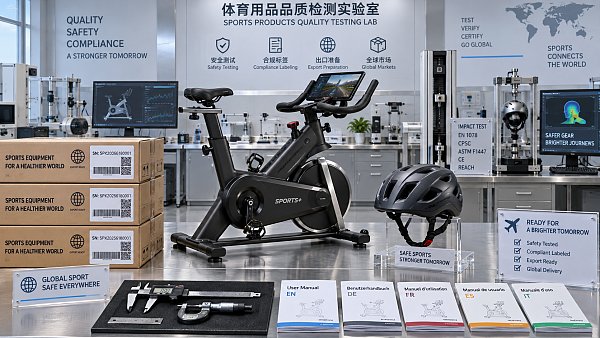
This is particularly relevant for commercial fitness equipment. A treadmill, exercise bike, rowing machine, or strength-training station may involve mechanical stability, pinch-point control, emergency-stop design, electrical safety, electromagnetic compatibility, software functions, and user-information requirements. The compliance path cannot be established from a product photo alone.
The EU: A Framework Built Around Market Access, Traceability, and Defined Responsibilities
In the EU, a sports product is generally subject to the General Product Safety Regulation (GPSR) unless more specific Union legislation applies. The GPSR emphasizes that consumer products placed on the market must be safe, supported by risk assessment, traceability information, and appropriate instructions or warnings. It also strengthens the practical importance of identifying responsible economic operators and handling corrective actions when safety issues arise.
CE marking is not a universal badge for all sports goods. It is required only where the product falls within legislation that specifically requires it. For example, personal protective equipment may fall under the EU PPE Regulation when it is designed to protect users against relevant risks. Electrical or connected fitness products may also need assessment under applicable electrical, electromagnetic compatibility, radio equipment, battery, or hazardous-substance rules, depending on their design and functions.
That distinction is commercially important. Placing a CE mark on a non-CE product can itself create a compliance problem, because it suggests conformity with legislation that may not apply. Conversely, omitting the mark from a product that does require it may block market entry. The correct question is not “Does Europe need CE?” but “Which EU legislation applies to this exact product, and what conformity route does that legislation require?”
EU exporters should also expect more emphasis on documentation discipline. Depending on the applicable rules, this may include a technical file, risk analysis, conformity assessment records, test evidence, a Declaration of Conformity, product identification, manufacturer details, and importer or responsible-person information. Instructions and safety information must be understandable to users in the relevant destination market. Language needs are not identical across the EU, so a single English-only instruction booklet is not automatically enough.
The US: Federal Rules, State Requirements, and Voluntary Standards Work Together
The US does not operate a single CE-style system for sports equipment. There is no broad, general “US conformity mark” that proves a product is acceptable in every state and sales channel. Instead, the applicable route depends on product type, age grading, product claims, and the agencies or rules involved.
The Consumer Product Safety Commission is central to many consumer sports products. Certain items, such as bicycle helmets, are subject to specific federal safety requirements. Children’s products can trigger additional obligations under the Consumer Product Safety Improvement Act, including requirements related to lead, certain phthalates, tracking labels, third-party testing, and Children’s Product Certificates where applicable. A junior sports set, child-sized protective product, or play-and-sport hybrid item should therefore not be treated as a scaled-down adult product.
For many adult sports goods, mandatory federal standards may be limited or product-specific. That does not mean technical expectations are low. ASTM, ANSI, UL, NOCSAE, and other standards may be requested by retailers, insurers, institutional buyers, sports organizations, or online marketplaces. Some standards are voluntary in a legal sense but decisive in a commercial one. A supplier may be able to import a product without a particular voluntary certification, yet still lose access to a national retail program because the buyer requires it.
State-level obligations add another layer. California’s Proposition 65 is frequently considered during material and packaging review because it may require warnings for exposures to listed chemicals. It is not a national product approval system, and whether a warning is needed depends on exposure and legal assessment, not merely the presence of a substance in a material list. Textile-based sportswear, grips, foam components, coatings, PVC parts, and accessories may all need careful chemical review.
Where the Practical Differences Become Visible
The table is a planning tool, not a substitute for classification. A connected indoor bike, for instance, can require an EU review of radio and electrical obligations while the US version may need consideration of Federal Communications Commission requirements for intentional or unintentional radio-frequency emissions. If the same product has a rechargeable battery, battery transport documentation and market-specific battery obligations should be considered separately from the fitness machine’s mechanical safety evaluation.
Testing Is Not the Same as Compliance
A laboratory report is evidence for a defined sample against a defined method at a defined time. It does not automatically cover later material substitutions, firmware changes, new colorants, altered packaging, revised load ratings, or a different target age. This matters in sports equipment because small design changes can affect real hazards: a changed weld geometry may alter fatigue behavior; a softer foam may affect impact performance; a new lubricant may affect chemical review; a revised console may introduce wireless or EMC questions.
Manufacturers should connect testing to change control. Bill-of-material updates, supplier changes, mold revisions, and new user claims should trigger a review of whether previous evidence remains valid. For equipment with load-bearing structures, the declared user weight, use environment, assembly method, and maintenance assumptions should remain consistent across product labeling, instructions, technical documents, sales pages, and retailer data sheets. A product cannot safely claim “commercial use” in a catalog while its validation and warranty conditions only support light household use.
Claims Create Their Own Compliance Exposure
Export teams sometimes focus on hardware and overlook marketing language. Terms such as “protective,” “injury prevention,” “medical-grade,” “professional competition,” “waterproof,” “child-safe,” or “smart health monitoring” can change the way a buyer, authority, or claimant interprets a product. Performance claims should be supported by relevant evidence and should not exceed the tested configuration or intended-use conditions.
This is especially sensitive for helmets, pads, braces, wearable electronics, heart-rate features, and recovery products. A sports tracker that displays wellness information is not automatically a medical device, but promotional wording can create questions that are separate from its basic consumer-electronics compliance. Similarly, protective equipment should be described according to the risk it is designed and assessed to address, rather than with broad promises of safety in every sporting situation.
A More Reliable Export Workflow
The efficient approach is to build a market-specific compliance matrix before production is finalized. It should identify the SKU, intended user, age grade, product claims, applicable legal categories, target countries or states, likely standards, labeling languages, document owner, and evidence still needed. This is more useful than maintaining a folder called “certificates” with reports that nobody has matched to current production.
For EU launches, verify whether the item requires CE marking, who acts as the relevant economic operator, what information must appear on the product or packaging, and which destination languages apply. For US launches, separate mandatory federal requirements from retailer specifications and state-level concerns. Confirm whether the product is a children’s product, whether electronic functions create additional obligations, and whether chemical, textile, packaging, or warning requirements need review.
Buyers should ask suppliers for more than a certificate image. Useful questions include: Which exact model and revision does this report cover? Was the sample production-representative? Which markets and claims were considered? Has the component list changed? Who will maintain traceability records and manage a corrective action if one is needed? Those questions reveal whether compliance is embedded in the supplier’s process or treated as a last-minute export document.
Build One Product Platform, Then Control the Differences
A shared product platform can reduce duplicated engineering, but EU and US versions should not be assumed identical. The most workable strategy is usually a common core design with controlled regional differences in labels, manuals, declarations, warnings, plugs, radio settings, packaging data, and evidence files. That approach protects manufacturing efficiency without hiding market-specific obligations.
For sports equipment suppliers, compliance is closely tied to biomechanics, material durability, assembly quality, and honest use instructions. RLES follows these intersections across commercial fitness machines, sports gear, connected consumer products, functional textiles, polymer components, and children’s learning-and-play categories. The useful question is rarely whether a product has “passed” in the abstract. It is whether the current product, current claims, current materials, and current sales route are aligned for the market where it will actually be used.
Before shipment, exporters should validate that alignment one more time against the final SKU specification and destination plan. That final review is often less expensive than relabeling inventory, delaying a retailer launch, or explaining why a test report no longer matches the product in the container.
The Archive Newsletter
Critical industrial intelligence delivered every Tuesday. Peer-reviewed summaries of the week's most impactful logistics and market shifts.