Monday, May 22, 2024

Can Carbon Fiber Products Develop Hidden Cracks After an Impact?
A carbon-fiber bicycle frame that falls against a rack, a racket that clips a court barrier, or a composite luggage shell dropped during handling may look almost unchanged afterward. Paint can remain intact, the surface may feel smooth, and there may be no obvious dent. Yet the answer to “Are carbon fiber products at risk of hidden crack damage after impact?” is yes. Carbon-fiber composites can develop internal damage that is not visible from the outside, including delamination between layers, resin cracking, fiber fracture, and crushed core material in sandwich constructions.
This matters because carbon fiber does not respond to impact like a ductile metal. Aluminum may bend or dent and provide a visible warning. A composite part can retain its shape while losing part of its load-bearing capacity in a concentrated area. The right response is not to assume every impact has caused failure, but to assess the impact location, force, product function, visible symptoms, and the consequences if the component later fails under load.
Why a smooth surface does not prove that the part is sound
Most carbon-fiber consumer products are composite structures: strong carbon fibers are arranged in layers and held in place by a polymer resin. Their performance depends not only on the fibers themselves, but also on the bond between layers and on the integrity of the resin matrix. An impact can damage one of these elements without breaking the outer cosmetic layer.
A sharp local strike may fracture fibers beneath the surface. A broad impact can create interlaminar stress that separates adjacent plies, known as delamination. In a hollow tube, such as a bicycle handlebar or sports shaft, the inner wall can be damaged even when the outer wall seems normal. In a hard-shell travel product, impact at a corner or near a wheel mount can create internal cracking around reinforcements or molded inserts.
The risk rises where geometry already concentrates stress: joints, cutouts, mounting holes, corners, transitions from thick to thin sections, and areas where hardware transfers load into the composite. A small impact on the middle of a lightly loaded panel may be less serious than a similar blow close to a pedal insert, hinge mount, handle attachment, or suspension connection.
Damage patterns that may remain hidden
“Hidden crack” is often used loosely. In practice, several different failure modes can exist, and their seriousness depends on the product’s structure and intended load.
- Matrix cracking: Small fractures in the resin around the fibers. These may begin as faint lines, a dull patch, or no visible sign at all. Matrix cracks can permit moisture ingress and reduce load transfer between fibers.
- Delamination: Separation between composite layers. This can reduce stiffness and allow damage to grow during repeated flexing or vibration.
- Fiber breakage: Broken carbon fibers reduce the strength of the affected load path. This is more concerning in parts that experience high tensile, compressive, or fatigue loads.
- Crushed core: Sandwich panels may use foam, honeycomb, or another lightweight core between skins. An impact can crush this core, leaving the outside skin apparently intact but less supported.
- Bond-line failure: Adhesive joints, bonded inserts, and bonded shells can partially separate after a shock. The damage may appear only when the part is loaded or moved.
Not every surface mark indicates structural failure. Scratches in clear coat, chipped paint, and shallow cosmetic scuffs are common. The difficulty is that cosmetic damage and structural damage can occur together, and visual appearance alone may not reliably distinguish them.
Start with the impact, not just the mark
When assessing a carbon-fiber product, the impact event provides useful context. A low-speed contact with a soft object is different from a drop onto concrete, a strike against a sharp metal edge, or a crush event during transport. The same visible mark can represent very different internal conditions depending on how the load entered the structure.
Record what is known before the item is cleaned, repaired, or returned to service. Identify where it was hit, whether the product was carrying load at the time, whether the impact involved a narrow edge, and whether it was later exposed to bending, pedaling, rolling, vibration, or temperature changes. For a procurement or quality review, photographs taken from several angles and a simple note of the event can make later assessment much more reliable.
Pay particular attention when the impact occurred near a structural interface. Examples include a carbon-fiber bicycle fork near the crown or dropout, a tennis racket around the throat, a golf shaft near the hosel, a composite helmet shell after a hard strike, or a luggage shell close to wheel housings and telescopic-handle fasteners. These regions often combine localized force with repeated service loads.
A practical first inspection
Begin with a clean, dry surface under strong angled lighting. Direct front lighting can hide shallow depressions and waviness; light cast across the surface is better at revealing changes in texture or contour. Compare the suspected area with the corresponding area on the opposite side when the product has a symmetrical design.
- Look for shape changes. Search for dents, raised areas, ripples, wrinkles, paint cracking, exposed fibers, cloudy patches beneath a clear finish, or a line that follows the direction of the weave.
- Inspect edges and attachments. Check around bolts, inserts, seams, bonded sections, wheel mounts, straps, handles, and hardware. Loose fittings or new gaps can point to local damage or bond failure.
- Use gentle touch. With clean fingers, feel for a soft spot, an abrupt change in stiffness, a depression, or an edge where the laminate seems lifted. Do not press hard enough to enlarge a possible delamination.
- Listen cautiously. A light tap comparison may reveal a duller sound over a delaminated zone than over an intact area. This method is only a screening tool: curved surfaces, varying laminate thickness, internal foam, and hardware can all change the sound.
- Check function without forcing it. A luggage shell may show abnormal flex around a wheel housing; a sports component may creak, shift, or display misalignment. Stop if a load test produces unusual noise, cracking, or movement.
A tap test is frequently overestimated. It can help identify a suspicious region in a relatively uniform laminate, but it cannot certify that a part is undamaged. A good sound does not rule out fiber fracture, damage on the far side of a tube, or a small defect beneath a thick finish.
When a visual inspection is enough—and when it is not
A limited inspection may be reasonable after a minor, clearly superficial event on a non-critical decorative panel. For example, a light surface scrape that affects only the coating, with no deformation, no localized softness, and no nearby structural attachment, may only require monitoring and finish repair according to the manufacturer’s guidance.
The threshold should be much lower for load-bearing or safety-related components. A carbon-fiber fork, handlebar, seatpost, climbing-related product, protective shell, high-performance sports frame, or structural luggage component can be subjected to repeated stress long after the initial impact. Continuing to use a compromised part may allow a small defect to propagate. Sudden fracture is not guaranteed, but the uncertainty is often unacceptable when failure could cause injury or loss of control.
Inspection methods used beyond the surface
Where the consequences justify further examination, non-destructive inspection can provide much better evidence than visual checks. The most suitable method depends on the product size, construction, finish, access, and suspected defect type.
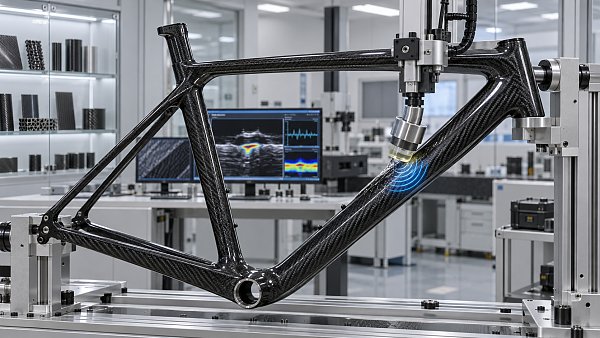
Ultrasonic inspection is widely used for composite laminates because sound waves can reveal delamination, voids, and thickness changes. It is especially useful on accessible, relatively smooth areas, though complex shapes and internal structures can complicate interpretation. Infrared thermography may help identify areas with different heat flow, which can indicate delamination or disbonding. Radiographic methods can reveal some internal conditions but may be less effective for certain planar delaminations. In production environments, manufacturers may also use controlled tap testing, laser shearography, or other validated methods suited to their component design.
These methods require trained interpretation. A scan should be assessed against the part’s construction and acceptance criteria rather than treated as a simple pass-or-fail image. For buyers evaluating incoming composite goods, the useful question is not merely whether a supplier performs an inspection, but whether the inspection method is appropriate for likely damage locations, laminate thickness, and the product’s intended duty.
Do not hide the evidence with a quick repair
Applying resin, paint, vinyl wrap, or filler over an impact zone before determining the extent of damage can make later assessment harder. A cosmetic patch may improve appearance while leaving broken fibers or separated layers underneath. Drilling, sanding, or aggressively polishing the area can also remove protective material or enlarge a local defect.
Structural repair is possible for some carbon-fiber products, but it is not interchangeable with cosmetic refinishing. A sound repair usually requires damage mapping, removal of compromised material, controlled surface preparation, correctly oriented replacement plies, compatible resin, cure control, and post-repair inspection. Whether repair is appropriate depends on the original laminate design, the location, the required strength, and manufacturer instructions. Components with safety-critical functions may have restrictions on repair or may need replacement rather than field restoration.
How to reduce hidden-impact risk in routine handling
Prevention is mostly about avoiding concentrated shocks and uncontrolled clamping. Store composite products where they cannot fall against hard edges. Use padded separators in transport, especially around tubes, corners, thin shells, and exposed hardware. Do not clamp directly onto unsupported carbon surfaces unless the product maker specifically allows it and provides a clamping location and torque guidance.
During assembly, use specified fasteners, torque values, and interface parts. Excessive tightening can create local compression damage that resembles impact damage later. For luggage and consumer shells, assess not only the visible panel but also the areas where wheels, handles, hinges, and internal frames transmit repeated force. For sporting products, inspect after crashes, impacts with fixed objects, and any event followed by a new creak, vibration, or change in alignment.
Questions that often arise after a carbon-fiber impact
Can carbon fiber crack internally without any visible mark?
Yes. Delamination, inner-wall damage, and small resin fractures may not alter the outer finish. This is why the impact location and the product’s function matter as much as surface appearance.
Will a damaged carbon-fiber part always make a cracking sound?
No. Some damaged parts remain quiet until they are heavily loaded, and some harmless finish defects can make noise. A new creak or click after an impact is a reason to inspect more carefully, but sound alone is not a diagnosis.
Can I keep using the product if it passed a tap test?
A normal tap response is not enough to clear a safety-sensitive component. It may support an initial screening, but it cannot reliably detect every type of internal damage. Consider the impact severity, location, visible condition, and manufacturer guidance.
Is a scratch across carbon weave automatically structural damage?
Not automatically. A scratch may affect only paint or clear coat, but a deep groove can cut fibers. If fibers are exposed, the surface is dented, or the scratch lies near a high-load attachment, treat it as more than a cosmetic issue until assessed.
The Archive Newsletter
Critical industrial intelligence delivered every Tuesday. Peer-reviewed summaries of the week's most impactful logistics and market shifts.